Research you can use
Findings, context, and a next stepWhat deserves your attention?
Recent studies reveal more about the steps between a buyer's question and an AI answer. The practical question is where your business is being missed and whether addressing that gap matters to buyers.
| Evidence | What's new or newly useful | What it supports doing |
|---|---|---|
| Traffic analysis | A 100-site sample found much less referral traffic from LLMs than from Google organic | Check your own channel contribution before reallocating budget |
| Telemetry research | Recorded browser traffic distinguishes pooled sources from cited sources | Separate discovery and citation checks |
| Citation research | Retrieval and question relevance explain more than common page-formatting prescriptions in the authors' preprint | Investigate which question a page answers before adding formatting |
| Location research | A preprint finds that location changes sources in controlled tests of ChatGPT and Gemini | Record location and repeat observations under comparable conditions |
| Attention signals | A Google Trends comparison and marketer surveys show interest in AI search alongside continued SEO language | Separate vocabulary changes from evidence of useful work |
| Official platform guidance | Google emphasizes distinctive content and SEO foundations; OpenAI separates search access from training controls | Check the relevant platform's requirements before paying for additional AI-specific work |
These studies examine different populations and outcomes. Their results shouldn't be combined into a single AI visibility benchmark.
Should AI referrals change your search budget?
Use your own qualified traffic and conversions to make that decision. A high conversion rate from a small channel can still produce little total business.
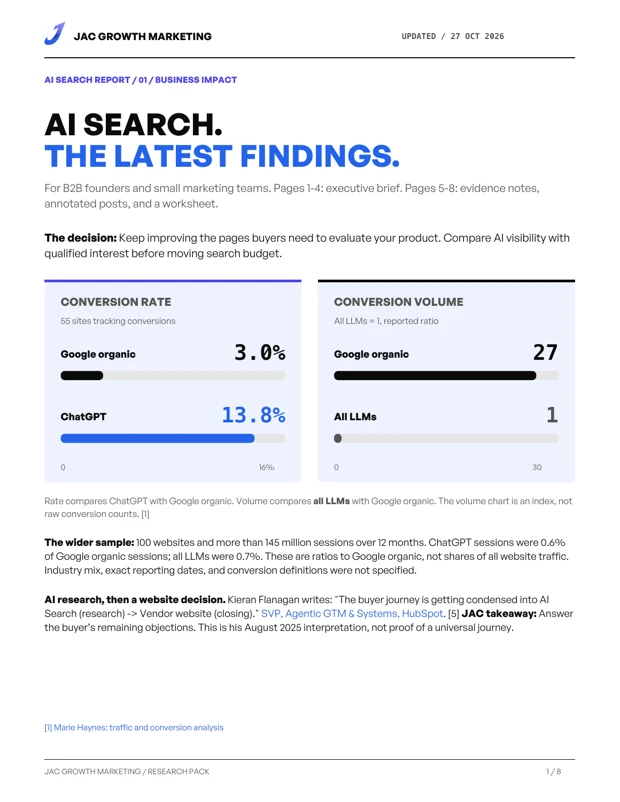
In an analysis of 100 websites and more than 145 million sessions, Marie Haynes found that ChatGPT sessions were 0.6% of Google organic sessions. Including other LLMs raised the ratio to 0.7%. Those are comparisons with Google organic, not percentages of all website traffic.
Among the 55 sites tracking conversions, ChatGPT's conversion rate was 13.8%, compared with 3.0% for Google organic. Google nevertheless drove 27 times as many conversions as all LLMs combined in the reported comparison.
Conversion rate
55 sites tracking conversions
Conversion volume
Reported ratio, all LLMs = 1
A higher conversion rate can coexist with much lower total volume. The rate panel compares ChatGPT; the volume panel compares all LLMs.
Recreated from the published figures. The left panel compares Google with ChatGPT; the right compares Google with all LLMs. Conversion definitions and the industry mix were not specified.
The sample does not explain why a visitor converts. In an August 2025 post about AI search and the buyer journey, HubSpot’s Kieran Flanagan offers a strategic interpretation:

“The buyer journey is getting condensed into AI Search (research) -> Vendor website (closing).”
This is Flanagan’s interpretation, not a controlled explanation of the conversion gap or proof that every buyer researches this way. The referral sample also cannot measure every influence on a purchase that arrives through another channel.
For a small B2B team, keep an AI referral segment beside your established search reporting. Add a way for buyers to tell you how they found the business. Compare relevant inquiries and completed actions before deciding which work to expand.
Why can a page be found without being cited?
AI search systems can retrieve or consult a larger pool of sources than they display in an answer. Getting into that pool and being selected are different checks.
Steve Toth's research across 277 recorded conversations used browser traffic captured in one day. For the pooled-versus-cited comparison, the study examined 15 three-turn conversations per platform, or 45 turns each.
Across that comparison, the reported share of pooled entries never cited ranged from 52% to 75%. These are pooled entries, not proof that an entire page was read or that every entry represents a unique URL.
Retrieval is an opportunity to inform the answer. It does not ensure a visible citation.
Recreated from the study's rounded percentages. Each platform comparison covers 45 turns; the recordings came from three B2B SaaS categories on one day. Platform telemetry differs, so treat the comparison as directional.
The useful distinction in the study is simple:

“Getting retrieved is only the first step. The page also has to answer the exact question the model is writing about.”
If a page is inaccessible, investigate access. If it is retrieved but repeatedly omitted, compare its answer and evidence with the selected sources. A bot request by itself can't tell you that a buyer saw the business or that a page influenced an answer.
For an inventory software business, an illustrative buying question is, "Can this platform sync stock across multiple warehouses?" Save the exact question, platform, country, run time, answer, and cited URLs. Check the answer against the product documentation. If the tool doesn't expose its source pool, record retrieval as unknown. A missing citation alone doesn't locate the failure.
Does covering more questions improve citation rates?
Not automatically. A focused answer can be more useful than a page trying to cover every related question, but there is no universal winning length.
The study by AirOps and Kevin Indig analyzed 16,851 queries, each run through ChatGPT three times. It reported 353,799 scraped pages and 815,484 query-page-run scoring rows. Those are different units, not interchangeable sample counts.
Within the study's strong query-match group, pages covering 26% to 50% of the generated subtopics had a 38.2% citation rate. Pages covering every subtopic had a 34.0% rate.
Among strong primary-query matches, by subtopic coverage
Zero-based scale to 50%. These selected bands are not exhaustive. This observational comparison does not establish that shortening a page improves citations.
Recreated from the study's primary similarity threshold of at least 0.8. Coverage was calculated from heading embeddings. This is an observational comparison within one ChatGPT study, not a test proving that shortening a page causes more citations.
Coverage across a useful set of pages and coverage of every subtopic on one page are different decisions.
For example, a B2B product may need separate answers about implementation, integrations, and alternatives. Each deserves a page only when there is a distinct buyer need and enough evidence to answer it well. This is an illustrative planning example, not a reported client result.
Keep a substantial guide when readers need the full explanation. Create a focused supporting page when a narrower decision needs detail. Avoid multiplying nearly identical pages for slight prompt variations.
How much should you invest outside your website?
Start with the question buyers are asking. Independent reviews and product specifications serve different purposes.
In an analysis of 240 branded prompts, Cate Dombrowski examined sources returned across five AI search systems and four industries. The study reported 23,387 unique sources, with a source classification that distinguishes independent media from other commercial brands.
| Question type | Published finding | Practical implication |
|---|---|---|
| Customer reviews | Earned media accounted for 82% of citations | Make real customer evidence available where buyers evaluate vendors |
| Functionality and integrations | Owned content appeared most frequently, at 50% | Keep product facts and integration information useful and current |
The percentages come from different intent groups. They aren't competing shares of a single total, and branded prompts don't represent all AI search activity.
Ahrefs CMO Tim Soulo gives a concrete example of why your own sources still need attention. In an interview about AI search and brand visibility, Soulo describes finding a two-year-old pricing article among the company's most-cited pages. The team asked product marketing to update it.
Before pursuing more mentions, inspect whether the pages already shaping answers contain outdated prices or product claims. This is one company's operating example, not a benchmark for how often AI cites stale information.
For B2B brands, that suggests checking whether the information on your site can stand on its own, then identifying credible external sources buyers use. A relevant customer review and an accurate industry comparison give readers evidence to evaluate. A passing mention may offer very little.
Which tactics should you deprioritize?
Deprioritize work sold as an AI visibility shortcut without evidence for the outcome you need. Some ideas lack supporting evidence; others are unnecessary for a particular platform. Neither means they once worked and have now stopped.
| Proposed shortcut | What the evidence supports | Practical decision |
|---|---|---|
| Add schema to get more AI citations | An Ahrefs matched-control study found no clear citation uplift for pages already being cited | Keep relevant schema for its documented uses; don't make it the centerpiece of a citation program |
| Add an llms.txt file or special AI markup | Google says special AI files and special schema aren't requirements for its generative search features | Put access and accurate visible information ahead of additional AI-specific files |
| Follow a fixed answer length or cover every subtopic | The studies here don't establish a universal format or ideal length | Structure the page around the buyer's decision |
| Buy precise demand counts for individual AI prompts | Conversation context and varied wording complicate direct counting; some vendors estimate topic demand instead | Ask what is observed, clustered, or modelled before using a volume figure |
Ahrefs followed 1,885 pages that added JSON-LD schema and compared them with 4,000 matched controls. Its reported adjusted changes were -4.6% for AI Overviews, +2.4% for AI Mode, and +2.2% for ChatGPT. The latter two were statistically indistinguishable from zero. The authors couldn't clearly attribute the small AI Overview decline to schema either.
This is stronger evidence than simply noticing that cited pages often have markup, but it isn't a randomized experiment. The pages were already being cited, schema types were pooled, other page changes could coincide, and the study measured 30 days after addition. It doesn't establish that schema is useless for every page or purpose.
A preprint by Mahe Chen and Nick Koudas examined 158,099 answers and 468,037 citations across two commercial markets. It used API observations and English questions for US markets, which may differ from consumer interfaces and other regions. The authors distinguish differences between websites from differences between pages of the same website. Their analysis links question-matching titles and paragraphs with citations within websites; several common formatting effects don't carry through in the same way.
That helps explain why a practice can look effective across popular sites without proving that adding it will improve your page. The study is a preprint, and its results shouldn't be treated as settled across every market or engine.
The earlier AirOps study calls schema markup a "meaningful boost." Its pages-with-markup comparison, Ahrefs' matched-control design, and the preprint's within-website analysis ask different questions. A feature may be common on better-performing websites without being the reason a page receives citations. That is a reason to test the proposed change, rather than count agreement between headlines.
For Google's own generative search features, its current optimization guide says special AI text files, special schema, and tiny content chunks aren't requirements. It also warns against inauthentic mentions.
The practical priority is evidence a buyer can use. Answer a material question accurately, make the answer accessible, and show its basis. Add tables or summaries when they make the decision easier. Don't add them merely because another website with those features receives citations.
How does LinkedIn fit into AI search?
Jake Ward's checklist based on LinkedIn's AI-search guide makes a useful connection between expert publishing and information beyond the feed:

“Pick a small number of topics you want to own
Build depth around them with posts + articles
… Reinforce the same ideas beyond LinkedIn”
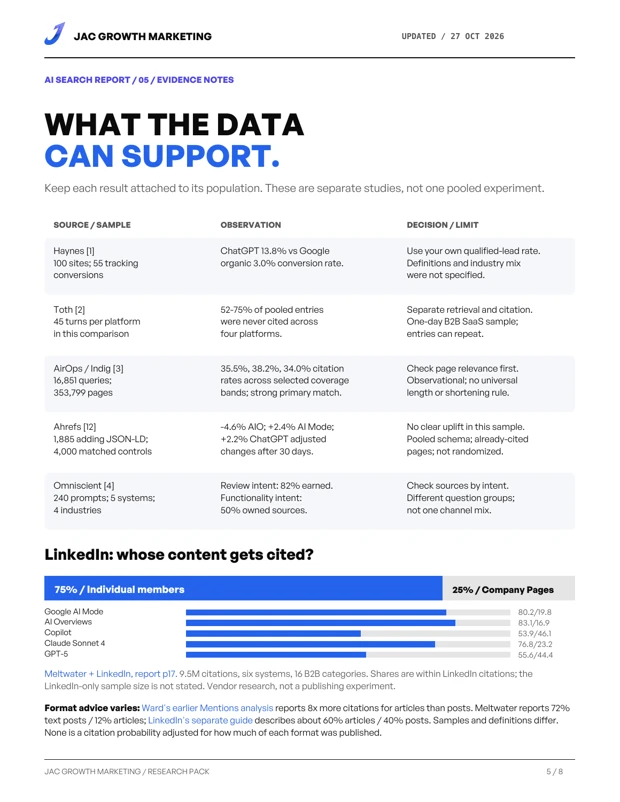
The underlying Meltwater research with LinkedIn analyzed 9.5 million citations across six AI systems and 16 B2B categories. It reports that individual members account for 75% of its LinkedIn citations, versus 25% for Company Pages. That is a split within the LinkedIn citations, not 75% of all AI answers or a per-post success rate.
Percentages are individual members / Company Pages. The published overall split is not an average of these rows. The study does not give a per-post success rate.
Recreated from page 17 of the original report. The overall figure is published separately, not calculated as an average of these model rows. Download the chart data.
The study's platform mix matters. It is vendor research about a selected B2B prompt set, not a controlled test of publishing more employee posts. The publisher describes a four-week project, but the inspected methodology doesn't give its exact calendar dates or the size of the LinkedIn-only subset.
Format advice needs its denominator. Ward's earlier Mentions analysis reports eight times as many citations for Pulse articles as regular posts, from 4.8 million answers and 13.4 million citations. Meltwater reports 72% text posts and 12% articles; LinkedIn's separate guide describes roughly 60% articles and 40% posts. These samples and format definitions aren't interchangeable, and none supplies a citation probability adjusted for how much of each format was published.
Our practical reading is to test a useful article alongside expert posts on the same buyer question. Keep the company facts accurate, and assess what the resulting AI answer says. An observed citation mix doesn't establish a universal winning length, posting frequency, or format.
What do Google and OpenAI recommend?
The platforms' own documentation is the starting point for eligibility and access requirements. Practitioner studies can help test opportunities beyond that baseline, but they don't replace the platform's stated rules.
Google's guide to optimizing for generative AI features emphasizes useful content that adds a distinctive perspective. It recommends organizing information for readers and using relevant, high-quality images and video. Creating pages for every variation of a question primarily to manipulate search visibility can violate its scaled-content-abuse policy.
That gives a research report a clear job: compare the methods, explain conflicting findings, and show what a reader should do differently. Repeating other publishers' statistics adds less value than explaining which conclusions their evidence can support. This is our editorial application of the guide, not a Google promise that a report will receive citations.
| Platform guidance | What to check | What it doesn't promise |
|---|---|---|
| Google's technical requirements and inclusion control | A page must be indexed and eligible for a snippet. Check the Search generative AI control in Search Console, including inherited settings; inclusion is the default | Meeting eligibility requirements doesn't establish that a page will appear for a particular question |
| OpenAI's ChatGPT search guidance | Allow OAI-SearchBot and confirm that the host or CDN permits traffic from OpenAI's published searchbot IP ranges | Placement isn't guaranteed |
| OpenAI's crawler controls | Treat search access and potential training use as separate choices. OAI-SearchBot is for search; GPTBot concerns potential model training | Allowing training isn't a prerequisite for allowing search access |
OpenAI also identifies ChatGPT-User as a user-triggered agent rather than its automatic search crawler. It isn't the control for search inclusion. Use the current crawler documentation when reviewing access rules, rather than treating every OpenAI user-agent as interchangeable.
Google's statements about unnecessary AI files and markup apply to Google's features. OpenAI's access documentation establishes its own crawler controls. Neither source supplies a universal formula for winning citations across every AI platform.
What is worth paying to measure?
In a LinkedIn post about prompt demand, Tim Soulo questions treating conversations as if they were conventional keyword searches. Follow-up messages, long instructions, and personalization make an individual prompt hard to count consistently. This is a practitioner critique, not proof that all topic-level demand research is impossible.
Semrush's methodology makes a useful distinction: it estimates volume for groups of related prompts using third-party interaction data and machine-learning models. That is a modelled topic estimate, not an exact census of how often a particular sentence was entered. Ask a provider to explain its unit, sample, platform coverage, and update schedule.
In a December 2025 post about choosing a measurement set, Soulo warns against a narrow view of AI visibility:

“The biggest mistake I see people make in AEO/GEO is measuring their AI visibility based on a tiny list of hyper-relevant prompts.”
The post accompanied Ahrefs’ custom-prompt launch, so it also has commercial context. Treat this as practitioner advice about measurement design, not proof of an ideal prompt count. A count of mentions alone does not establish buyer demand or commercial impact.
Where is attention shifting?
Interest in a category, adoption of a label, and results from doing the work are different signals. Look at them separately before treating a rise in GEO or AEO discussion as a reason to change your strategy.
We exported a Google Trends comparison for four full phrases: search engine optimization, generative engine optimization, answer engine optimization, and AI search optimization. It uses US Web Search, all categories, and one shared scale. Full phrases reduce the ambiguity of bare acronyms such as GEO and AEO.
One shared 0–100 index for full search phrases. Complete weeks only. Relative interest is not search volume, market share, or usage inside AI assistants.
Recreated from the exported weekly series. The requested window is five years; the chart keeps complete weeks and excludes the first overlapping bucket and final incomplete bucket. These are search terms, not Topics. Download the weekly data.
The newer phrases rise from a low base, while the SEO phrase remains larger in this comparison. The latest 13 complete weeks have lower average relative interest for all four phrases than the preceding 13 weeks. That complicates a simple story of attention moving steadily from SEO to a replacement discipline.
Google Trends measures relative interest, not monthly search counts or market share. Its official methodology describes sampling, normalization, and statistical noise; a zero may reflect insufficient volume. It also excludes internal searches made by Google's AI products. This chart doesn't measure the volume of questions people ask inside ChatGPT, or explain why a particular phrase rises or falls.
Surveys add a different view of what marketers are thinking:
| Signal | What respondents said | How to use it |
|---|---|---|
| Strategy and execution | In a Semrush survey of 481 respondents, 77% described AI search as an extension of SEO, but 22% reported fully integrated strategy, execution, and reporting | Build AI observations into existing search work rather than maintaining disconnected reports |
| Planned investment | In the same survey, 38% planned investment in AI search optimization, alongside 36% in traditional SEO | Teams can fund both; these choices aren't a zero-sum split |
| Buyer vocabulary | In Fractl's survey of 343 US marketing decision-makers, 81% still called their internal AI visibility strategy SEO; 36% named unexplained buzzwords as the leading vendor red flag | Explain the problem and the work in words the buyer understands |
These are vendor-led, self-reported surveys with different samples and questions, not a representative census of B2B buyers. Semrush reports an attention check and a mix of roles and company sizes. Its figures don't prove that adopting a particular workflow causes better results.
Our reading: The opportunity is to help teams understand which buying questions matter and what information is missing. A new acronym can help name the work, but it doesn't supply a method or demonstrate value. Search interest and survey responses help us choose useful explanations; observed buyer outcomes determine whether the work earns more investment.
What should your reporting measure now?
Keep visibility, visits, and qualified actions separate. Each answers a different question.
Google's generative AI performance report covers impressions for AI Overviews and AI Mode, with page, country, date, and device dimensions. If the report isn't visible, the site may lack sufficient impressions; absence doesn't establish that it is blocked.
This report documents impressions. It isn't a complete measure of AI-driven clicks, purchase influence, or visibility across other assistants.
A location audit, also a preprint by the same research team, tested 31,200 answers. It found that declared location and network location affected ChatGPT and Gemini differently. Record the location settings and access method alongside any prompt-based visibility observation.
The questions in your tracking set matter, too. On The Page 2 Podcast, Semrush's Marcus Tober cautions against treating homepage citation patterns as universal:

“I wouldn't generalize that the homepage is always the most cited page. … often most cited because the setup has prompts that would surface the homepage.”
His explanation is that prompt selection can favor homepages. Include questions about specific buying decisions alongside branded questions before deciding which pages need work. A useful practice is to keep the question set consistent between comparisons.
| Measurement | Useful for | Doesn't establish |
|---|---|---|
| Google generative AI impressions | Seeing eligible links shown in Google's supported features | Revenue or visibility in every assistant |
| Repeated prompt observations | Comparing specific answers under recorded conditions | A census of buyer searches |
| Referral visits and qualified actions | Understanding measurable activity reaching your site | Every influence that happened before the visit |
| Buyer-reported discovery | Learning how people describe finding you | Complete or exact attribution |
Our guide to measuring AI search visibility explains how to retain observations and compare checks. Apply the current platform documentation above when older reporting instructions differ.
Where does the evidence agree, and where does it stop?
The strongest agreement is that relevant information needs to be available for retrieval, while source selection and business impact need separate measurement. The research doesn't establish one formula for improving every outcome.
| Discussion | Evidence and disagreement | Decision for a small B2B team |
|---|---|---|
| SEO versus a separate GEO program | Platform guidance retains SEO fundamentals; telemetry shows additional retrieval and selection steps | Maintain search fundamentals and inspect the particular AI surface buyers use |
| Referral volume versus influence | The 100-site analysis shows limited LLM referrals; a HubSpot leader reports buyers attributing purchases to LLM recommendations | Measure both where possible, without inventing attribution |
| Broad coverage versus focused pages | The ChatGPT study favors moderate subtopic coverage within its comparison; broader site coverage may serve additional buyer needs | Give each page a clear job and use internal links for related decisions |
| Structure versus relevance | AirOps associates structure with citations; Ahrefs finds no clear schema uplift in already-cited pages, and the preprint questions several within-site effects | Use structure for clarity and test performance rather than assuming causation |
Several experts discussing one dataset don't constitute independent confirmation. Agreement between studies using different methods can strengthen a working interpretation, but it doesn't turn that interpretation into a guaranteed tactic.
What should you do next?
Choose one important buying question and check how well your business answers it. Save the evidence before changing the page so the next comparison has a baseline.
- Identify a question where inaccurate or missing information could affect a buyer's decision.
- Check the relevant page, a repeated sample of AI answers, and the sources those answers cite. Record the platform and location.
- Improve the verified information gap. Use the B2B AI search guide for implementation detail.
- Recheck under comparable conditions and review qualified interest separately from citation movement.
If you want help researching the questions, improving pages, and checking the results, AI Search & SEO covers that work. Book a call to discuss the questions your buyers need answered.

Research and analysis by Jared Castronova
Founder of JAC Growth Marketing. Helping B2B brands with AI search, SEO, and founder LinkedIn content.